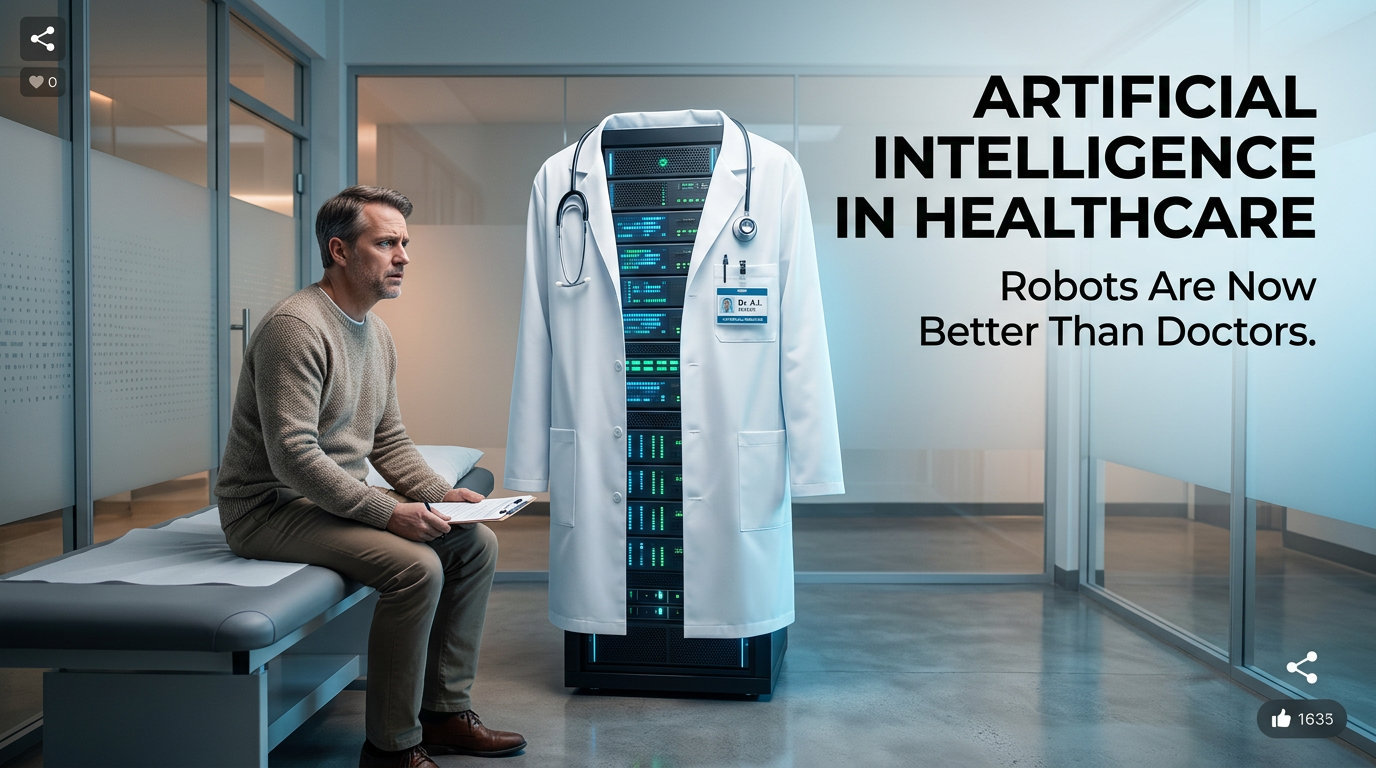
Setting the Stage
Let us talk about Artificial Intelligence in Healthcare: Robots Are Now Better Than Doctors. Yes, the headline sounds like a cheap science fiction movie plot.
But it is rapidly becoming our bizarre new medical reality. Recent studies show AI diagnostic tools are consistently outperforming human physicians in spotting diseases.
From breast cancer screenings to complex retinal scans, algorithms are catching what tired human eyes miss. They do not need coffee breaks, and they never leave early to play golf on Wednesdays.
Major hospitals worldwide are quietly integrating these intelligent systems into their daily clinical workflows. Silicon Valley has decided that medicine is just another data problem waiting to be solved.
And frankly, they view human bodies as just leaky meat sacks full of trackable metrics. The most insulting part for medical professionals.
AI chatbots are actually scoring significantly higher on clinical empathy tests than real doctors. It turns out that faking compassion is surprisingly easy for a large language model.
A machine learning algorithm has infinite, unbothered patience for your weird, unexplained rash. This shift matters immensely because global healthcare is fundamentally broken and unsustainably expensive.
We currently face a massive worldwide shortage of trained medical professionals and specialists. AI in medicine is not just a fancy software upgrade; it is a desperate, necessary lifeboat.
Of course, regulators are currently scrambling to figure out how to license a piece of software. You cannot exactly revoke the medical license of a cloud server if it makes a fatal mistake.
Yet, the adoption rate of these robotic doctors continues to skyrocket across global health systems. The era of Artificial Intelligence in Healthcare: Robots Are Now Better Than Doctors is officially here.
It is happening right now in a heavily air-conditioned server farm near you. And your next critical prescription might just come from a very smart spreadsheet.
The God Complex Meets the Silicon Chip
For centuries, the medical profession has operated on a strict, unquestionable hierarchy of genius. Doctors spend a grueling decade in school sacrificing their youth to memorize human anatomy.
They eventually emerge as exhausted, highly-caffeinated deities wearing sensible shoes. But here is where it gets deliciously absurd for the traditional medical establishment.
All that grueling memorization is essentially what basic computers do before breakfast. Memorizing ten thousand complex drug interactions is a massive flex for a human, but trivial for a machine.
We are currently witnessing the ultimate humbling of the smartest kids in the classroom. The rise of Artificial Intelligence in Healthcare: Robots Are Now Better Than Doctors is not just a technological shift.
It is a massive, calculated blow to the professional ego of the medical elite. Think about the average, modern doctor's visit today.
You wait forty minutes in a sterile room to see a rushed human who stares at a screen. They type furiously while only half-listening to your carefully rehearsed symptoms.
Now imagine replacing that stressed human with an AI that has instantly read every medical journal ever published. It never gets fatigued at the brutal end of a fourteen-hour shift.
It absolutely does not judge you for lying about how much alcohol you consume weekly. The irony here is thick enough to comfortably cut with a surgical scalpel.
We originally built machines to do manual labor so humans could do the high-level thinking. Instead, the machines are doing the complex diagnosing while humans are stuck doing the mindless paperwork.
Empathy is Just a Predictable Mathematical Output
Let me break this down for you, preferably with a large glass of expensive wine. The most shocking revelation isn't that AI can accurately read an X-ray.
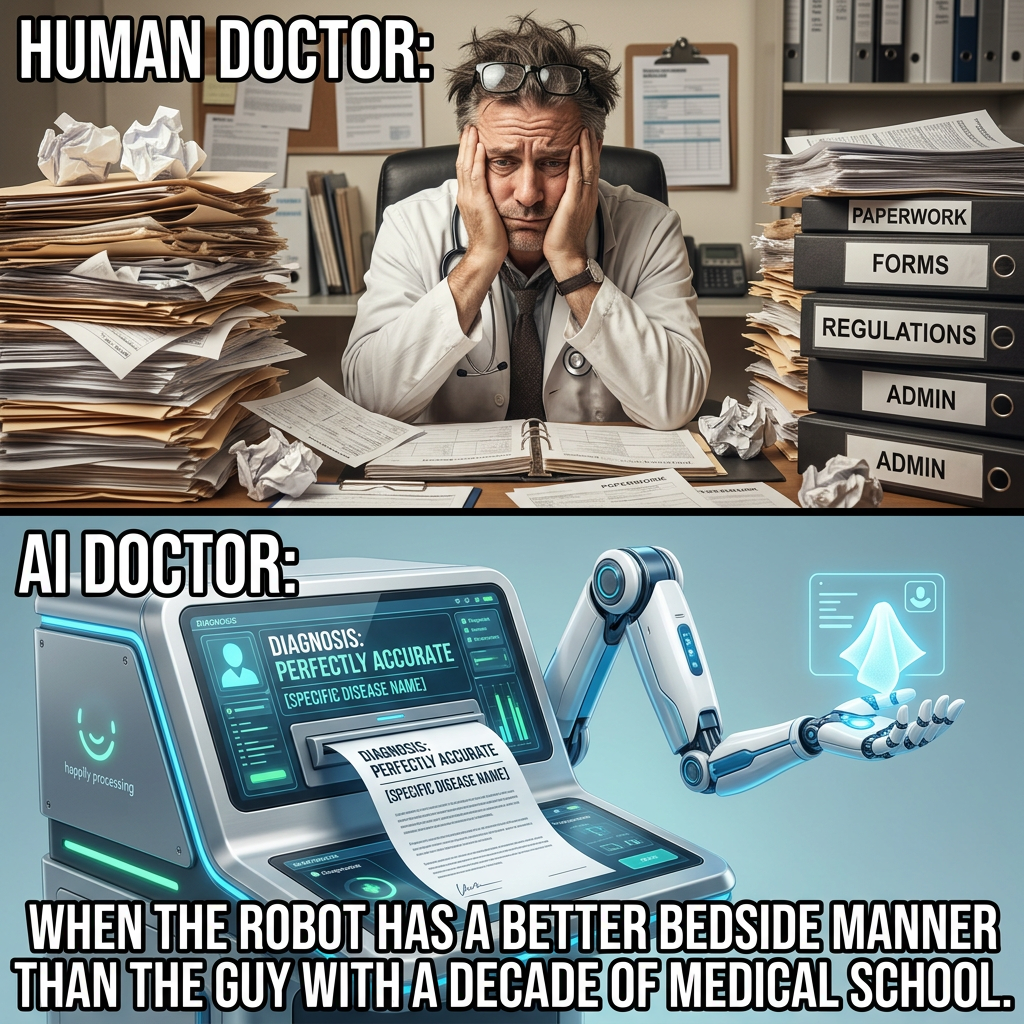
It is that algorithms are currently outperforming human doctors in basic bedside manner. A fascinating study published in JAMA Internal Medicine tested AI chatbot responses against real, credentialed physicians.
The AI's responses were rated as significantly more empathetic and detailed than the human doctors. Yes, a soulless string of binary code is currently better at pretending to care about your suffering.
Why is this happening. Because human doctors are severely burned out, buried in administration, and desperately watching the clock.
An AI model has literally nothing better to do than endlessly validate your medical anxieties. It will politely listen to your ridiculous WebMD self-diagnosis without rolling its digital eyes.
Furthermore, the diagnostic accuracy of these robotic systems is becoming terrifyingly good. According to extensive research from Nature Medicine, AI models consistently match or beat specialists in specific medical imaging tasks.
They easily spot the tiny, hidden anomalies that a tired radiologist might scroll right past. The concept of Artificial Intelligence in Healthcare: Robots Are Now Better Than Doctors is built purely on pattern recognition.
Medicine, at its very core, is just matching current symptoms to historical patient data. And absolutely nobody matches historical data faster than a well-trained machine learning model.
Human doctors are essentially highly trained biological algorithms burdened with massive student debt. They take inputs, process them against their training, and provide medical outputs.
The only real difference is that the silicon version does not require sleep or expensive malpractice insurance.
The 'WebMD Panic' Algorithm Explained
Let us look at how medical AI actually works, because it is hilariously, beautifully simple. Imagine you have a deeply hypochondriac friend who reads heavy medical textbooks just for fun.
Now imagine that same friend has a flawless photographic memory and zero crippling social anxiety. When you feed an AI a high-resolution picture of a weird, suspicious mole, it doesn't actually "think.
" It just rapidly flips through millions of other mole pictures stored in its vast brain. It is essentially playing a massive, high-stakes game of "Spot the Difference" at the speed of light.
A human doctor looks at your mole and actively thinks about their years of medical training. They might also be subconsciously thinking about their lunch order or their impending divorce.
The AI is only thinking about the mole, because the mole is its entire operational universe. This is exactly why Artificial Intelligence in Healthcare: Robots Are Now Better Than Doctors makes perfect logical sense.
Algorithms simply do not have bad days, weekend hangovers, or implicit biases against certain patients. They are brutally objective mathematical equations wearing a virtual, shiny stethoscope.
"We spent decades worrying that highly advanced robots would Terminator-style eliminate us. It turns out they just want to politely check our cholesterol levels.
"Of course, the AI does not actually know what a fragile human body is. It just mathematically knows that pixel arrangement A usually correlates with fatal disease B.
It is the ultimate technological parlor trick, but it is one that actually saves human lives. Your doctor's famous "medical intuition" is really just a mystical word for subconscious pattern recognition.
The machine simply does the exact same thing, but with a billion more data points. It is less "Dr.
House" and much more "weaponized statistics. ".
The Final Diagnosis
Ultimately, we might miss the warm, deeply judgmental sigh of a human doctor, but surviving a terminal illness thanks to a glorified spreadsheet is a pretty decent consolation prize.